TryllVoiceProfile
Type: ScriptableObject (sealed)
Namespace: Tryll.Client
Source: Runtime/TryllVoiceProfile.cs, Runtime/TryllVoiceProfileData.cs
Menu: Create → Tryll → Voice Profile
A character's voice as an asset: which TTS model speaks, the base identity
(speaker, reference clip or description), speed and language, whether a viseme
track is emitted, and named delivery modes (moods such as angry or
calm) that game code switches at runtime.
Assign the profile to a TryllAgentComponent's
Voice field. Every speaking node of that agent (Speak, GenerateAndSpeak)
uses it; the nodes hold no voice settings. Because the voice lives on the agent
and not in the workflow, one workflow asset can drive many characters, each with
its own profile.
A workflow with a speaking node cannot create an agent without a voice: the
server rejects it with AgentVoiceRequired (3025). There is no default voice
and no default model. A workflow that does not speak ignores the profile and
loads no TTS model.
Fields
The asset holds one TryllVoiceProfileData in its Data field.
| Field | Type | Default | Description |
|---|---|---|---|
TtsModelName |
string |
— | Required. TTS model catalog name, picked from the registered TTS models. |
SpeakerId |
int |
0 |
Speaker / style index for multi-speaker models (Supertonic 3: 0–9; Orpheus, Maya1: preset index). Must be below the model's speaker count. |
ReferenceVoice |
string |
empty | Reference clip (.wav) for clone models (Pocket TTS, Chatterbox, Qwen3-TTS Base), relative to the storage root. Locale-aware: voices/loc/<locale>/ is tried first. Empty = the model's default voice. |
VoiceDescription |
string |
empty | Maya1: natural-language identity of the voice. Overrides SpeakerId. |
Speed |
float |
1.0 |
Speech-rate multiplier, 0.1–3.0. Must stay 1.0 on models without speed control. |
Lang |
string |
empty | Language for multilingual models that pick it per call. Empty = session locale, then the model default. Rejected on models with a fixed language. |
Expressiveness |
float |
0.5 |
Chatterbox exaggeration, 0.0–2.0, used by neutral and by modes that do not set their own. Ignored by other models. |
Prepare |
TryllVoicePreparation |
Eager |
When reference clips are prepared: Eager (all clips when the voice is set, so the first sentence in a new mode has no extra latency) or Lazy (on first use). |
EmitVisemes |
bool |
false |
Emit a viseme track for every sentence the agent speaks. Turn on for characters with TryllLipSync. |
DeliveryModes |
List<TryllDeliveryMode> |
empty | Named deliveries (below). |
DefaultDeliveryMode |
string |
empty | Mode active after the voice is set. Empty = neutral. |
TryllDeliveryMode
| Field | Type | Default | Description |
|---|---|---|---|
Name |
string |
— | Mode name: 1–32 characters of a-z, 0-9, _, unique in the profile. neutral is built in and cannot be defined. |
ReferenceVoice |
string |
empty | Clone models: a clip of this character in this mood. Replaces the profile clip while the mode is active. |
Instruction |
string |
empty | Maya1: sustained delivery clause. A known keyword (angry, sad, whisper, …) becomes its tuned clause. A ticked Text ID in this field is not resolved; the text resolver only walks graph node params. |
Expressiveness |
float |
-1 |
Chatterbox exaggeration for this mode, 0.0–2.0. Negative = the profile value. |
SpeedScale |
float |
1.0 |
Multiplies the profile speed while the mode is active, 0.5–2.0. Must stay 1.0 on models without speed control. |
A mode with no fields set behaves like neutral. This lets every profile
define the same mode names, so game code that asks for angry works on any
voice, including models with no emotion channel.
A field the model cannot use (a reference clip on Supertonic, an instruction on
Qwen3-TTS) is an error: the server rejects the profile with
InvalidVoiceProfile (3023) when the voice is set.
Inspector
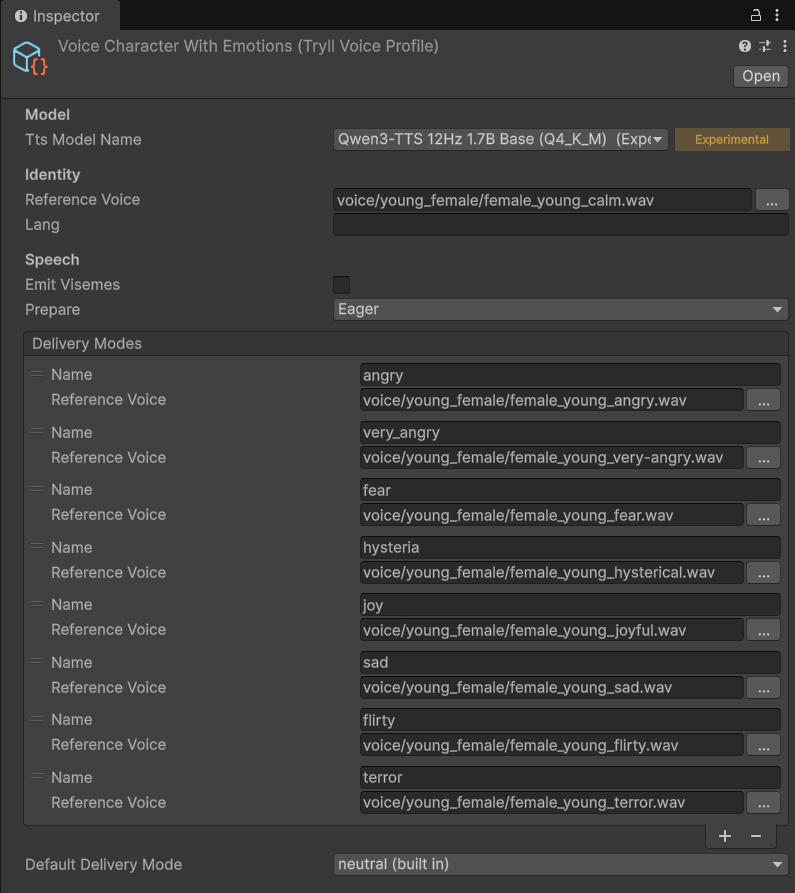
The custom Inspector shows only what the chosen model can use, read from the catalog's TTS capabilities:
- Speaker is a preset dropdown for models with named presets (Orpheus, Maya1), a slider for multi-speaker models (Supertonic 3), and hidden for single-speaker models.
- Reference Voice, Voice Description, Speed, Lang and Expressiveness appear only for models that support them. A field that holds a value the model cannot use stays visible so you can clear it.
- Delivery Modes is a reorderable list whose rows apply the same rules.
- Default Delivery Mode is a dropdown of the defined modes.
- Validation findings (missing model, bad mode names, unsupported fields, missing clip files) are shown at the bottom.
When the catalog cannot be read, every field is shown.
Assets ▸ Tryll ▸ Validate Workflow also validates selected voice profiles. A Windows Standalone build fails when a profile names a model that is not marked Production in the Model Manager.
Using a profile from code
// Spawning a character: set the voice before the agent is created.
var agent = go.AddComponent<TryllAgentComponent>();
agent.AutoCreateOnConnect = false;
agent.WorkflowAsset = merchantWorkflow;
agent.Voice = merchantVoice;          // TryllVoiceProfile asset
agent.CreateAgent();

// Mood: any time, including mid-turn; applies from the next sentence.
var err = await agent.SetDeliveryModeAsync("angry", intensity: 0.8f);

// Identity: idle (or paused) only.
err = await agent.SetVoiceAsync(disguisedVoice);
Without a component, build a TryllVoiceProfileData and pass it to
TryllClient.RequestCreateAgentAsync (voice:), then use
TryllAgent.SetVoiceAsync / SetDeliveryModeAsync.
public sealed class TryllVoiceProfileData
{
    public const string NeutralMode = "neutral";
    public TryllVoiceProfileData Clone();
    public Tryll.VoiceProfileT ToWire();
    public static TryllVoiceProfileData FromWire(Tryll.VoiceProfileT wire);
    public static bool IsValidModeName(string name);
}
| Error | When |
|---|---|
InvalidVoiceProfile (3023) |
A field fails validation or the model cannot use it. The message names the field and, for modes, the mode. |
UnknownDeliveryMode (3024) |
SetDeliveryModeAsync names a mode the profile does not define. |
AgentVoiceRequired (3025) |
A speaking workflow was created without a voice, or SetDeliveryModeAsync on an agent with no voice. |
AgentBusy (3004) |
SetVoiceAsync while a turn is running. |